
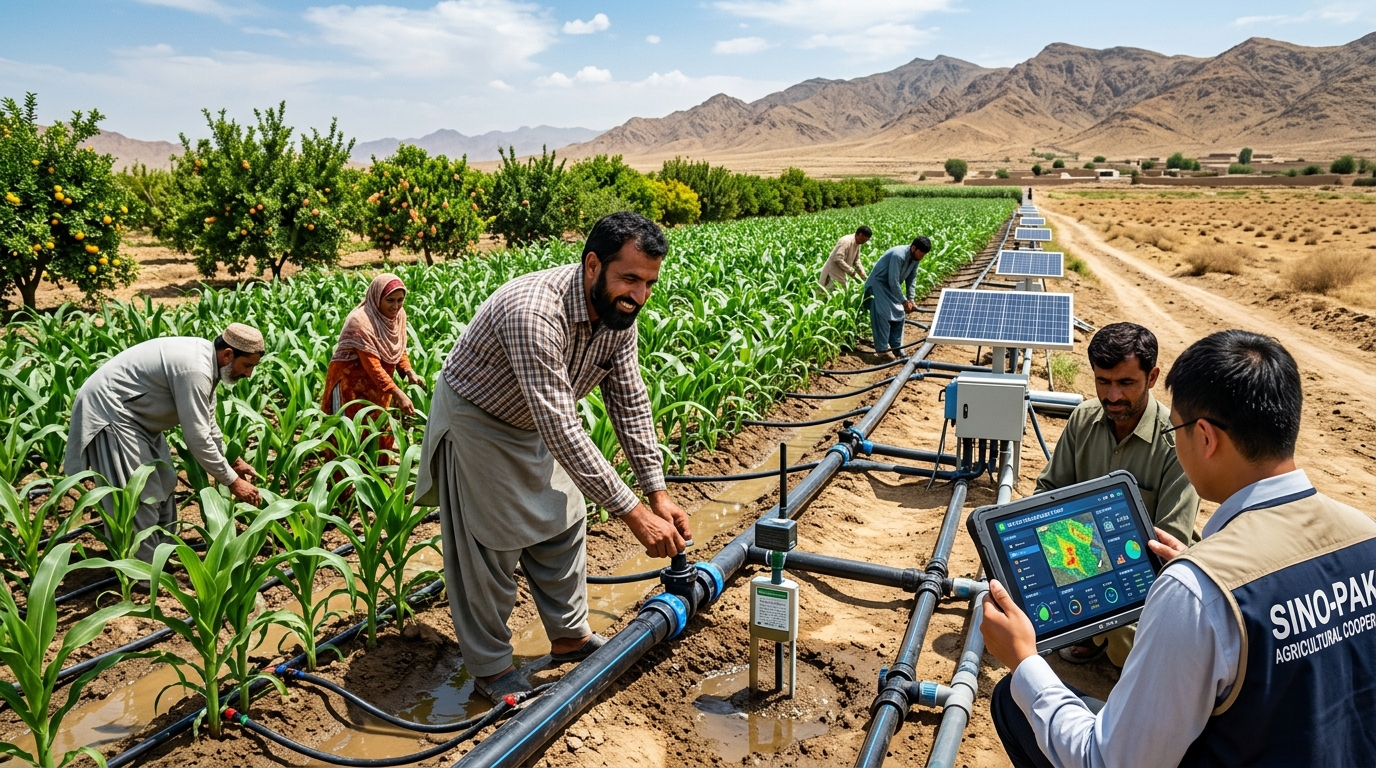
Chinese water-saving irrigation technology has shown promising results in Pakistan over the past two decades, with agricultural trials in Punjab and Sindh demonstrating significant improvements in water efficiency, crop production, and drought resistance.
Experts say advanced drip irrigation systems tested in Pakistan have helped reduce water usage by nearly 50% while substantially increasing agricultural productivity, particularly in maize farming.
Drip Irrigation Showing Strong Results in Pakistan
Agricultural specialists report that modern Chinese irrigation technologies have delivered several benefits during pilot projects, including:
- Reduced water consumption
- Higher crop yields
- Improved drought resistance
- Better fertilizer efficiency
- More sustainable farming practices
Some field trials reportedly doubled maize production while helping farmers manage crops more effectively during periods of water scarcity.
Pakistan Faces Growing Water and Food Security Challenges
Pakistan continues to face serious challenges linked to:
- Water shortages
- Climate change
- Declining agricultural productivity
- Rising food security concerns
- Inefficient irrigation systems
Agriculture remains a major part of Pakistan’s economy, but experts warn that traditional irrigation methods continue to waste large amounts of water in a country already facing increasing climate pressure.
China’s Xinjiang Model Drawing Attention
Agricultural analysts often point to Xinjiang as an example of how modern irrigation systems transformed farming productivity in regions with environmental conditions similar to Pakistan.
China began expanding drip irrigation systems in Xinjiang during the 1990s, helping convert arid agricultural areas into some of the country’s highest-yield farming regions.
Experts believe Pakistan could potentially replicate parts of this success through large-scale irrigation modernization and improved agricultural policies.
Major Obstacles Still Remain
Despite successful pilot programs, large-scale adoption in Pakistan remains limited due to several challenges, including:
- Unreliable electricity supply
- Water infrastructure problems
- High installation costs
- Limited farmer financing
- Lack of government subsidies
Agricultural experts note that China heavily subsidized farmers to encourage adoption of modern irrigation technologies, while Pakistan currently offers limited financial support for small-scale farmers seeking similar upgrades.
CPEC 2.0 and Agricultural Cooperation Expanding
The 2025–2029 China-Pakistan cooperation framework and China-Pakistan Economic Corridor initiatives reportedly include plans focused on:
- Drip irrigation capacity building
- Agricultural modernization
- Water conservation
- Climate-resilient farming
- Technology transfer programs
Officials say improving irrigation efficiency could play a major role in strengthening Pakistan’s long-term food security and agricultural sustainability.
Pakistan’s Policies May Decide the Outcome
Experts emphasize that imported technology alone may not solve Pakistan’s agricultural challenges unless supported by:
- Strong government policies
- Farmer subsidies
- Infrastructure investment
- Reliable energy systems
- Water management reforms
As climate change and water scarcity continue to intensify, analysts say Pakistan’s future agricultural productivity may increasingly depend on how effectively the country modernizes its irrigation systems and supports farmers adapting to changing environmental conditions.