
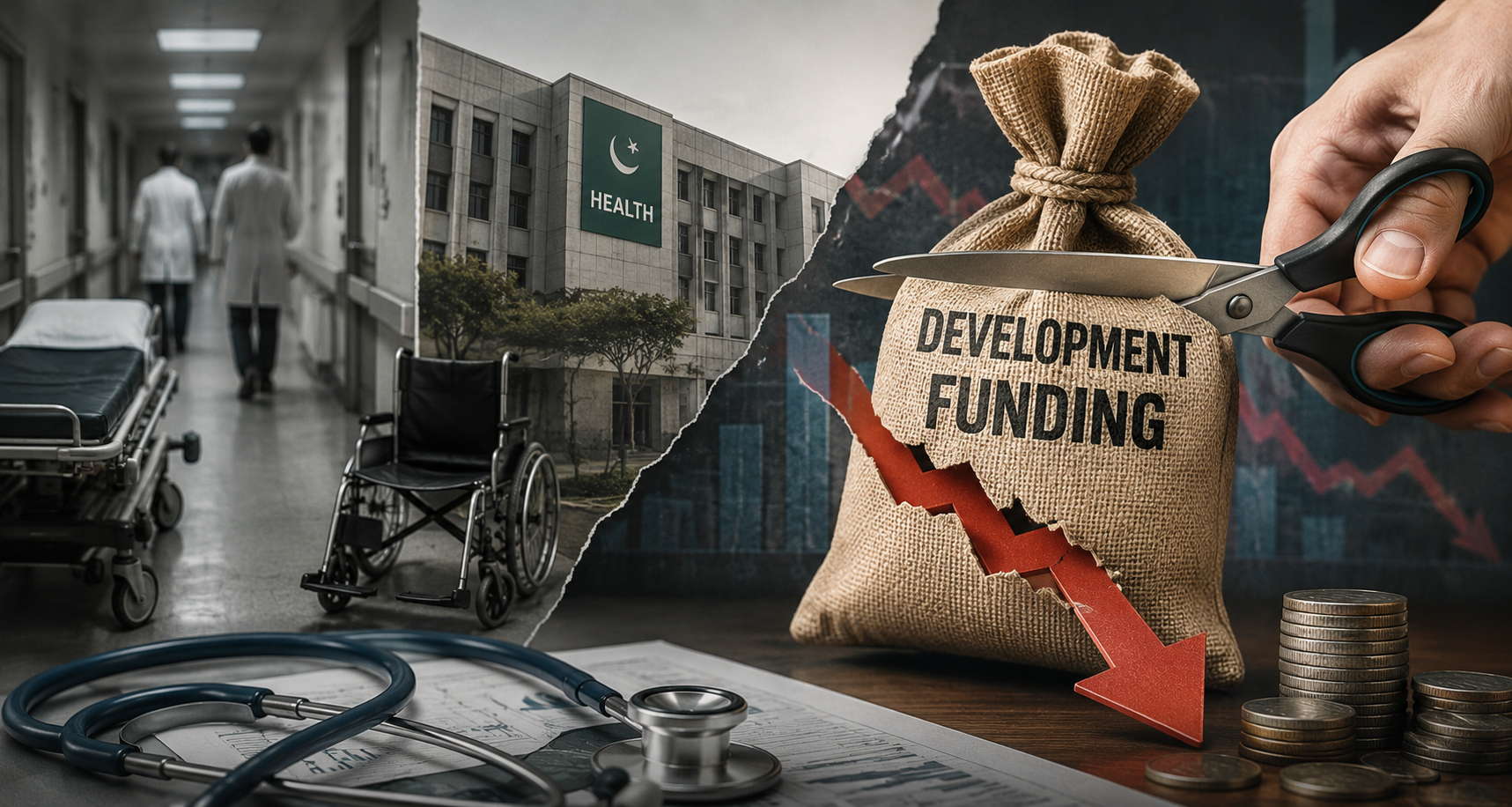
A new report by Pakistani think tank Tabadlab has warned that cuts in international development funding are posing a serious threat to Pakistan’s health sector, putting several critical health programmes at risk of complete collapse.
The report, titled “Beyond Dependence: Understanding the Impact of ODA Cuts on Pakistan’s Health System,” was authored by Shahab Siddiqi, Behzad Taimur and Syeda Farwa Qamar Jaffri. It warns that Pakistan’s health system is facing a functional breakdown as Official Development Assistance (ODA) — money received from international donors — continues to shrink, and that simply increasing the government’s own budget will not be enough to fix the problem.
What Is the Real Problem?
The report explains that Pakistan’s government budget mainly covers salaries and building costs. International donor funding, on the other hand, pays for vaccines, medicines, diagnostic tools and supply chains — the things that actually make health programmes work on the ground. When donor funding is cut, health facilities may still have staff but lose the essential supplies and tools needed to function properly.
Real Impact Already Being Felt
The report points to concrete examples of damage already caused by funding cuts:
- USAID’s suspension forced the closure of over 60 health facilities, disrupting healthcare for 1.7 million people
- A $27.2 million reduction from the Global Fund cut TB monitoring by half in Punjab and Khyber Pakhtunkhwa
- Financing for diagnostic kits was reduced significantly
- Treatment for tens of thousands of HIV-positive patients has been put at serious risk
Pakistan’s Low Health Spending
The report also highlights that Pakistan spends only 0.9 percent of its GDP on health — far below the World Health Organisation’s recommended minimum of 5 percent. This makes the country extremely dependent on international donors to keep its health programmes running.
Additionally, grant-based international assistance to Pakistan has already fallen by 59 percent since 2017, and global ODA is expected to decline by a further 5.9 percent in 2026 — suggesting this is not a temporary problem but a long-term shift.
What Does the Report Recommend?
The report calls for a structured plan to reduce dependence on foreign funding over time. Key recommendations include:
- Setting up a national health financing forum
- Creating a national ODA registry to track donor funding
- Developing a risk matrix to identify which health functions are most critical and hardest to replace
- Building time-bound transition plans for TB, HIV-AIDS and immunisation programmes
- Reforming procurement and hiring rules to allow more flexibility
- Gradually increasing public health spending toward 3 percent of GDP
- Strengthening local technical capacity and integrating vertical health programmes into primary care over the long term